LOC Wealth

Call Us

Debt Recycling Advice Gold Coast

Reduce home loan debt while building long-term investments through a structured strategy.

Turn Your Home Loan Into a Wealth-Building Strategy

Debt recycling is a long-term strategy that may help homeowners gradually reduce non-deductible home loan debt while building an investment portfolio.

LOC Wealth helps Gold Coast clients bring their lending structure, investment strategy, cash flow and risk management together in one coordinated debt recycling plan.

Before recommending a strategy, we assess whether it is appropriate for your financial position, borrowing capacity and long-term goals.

What Is Debt Recycling?

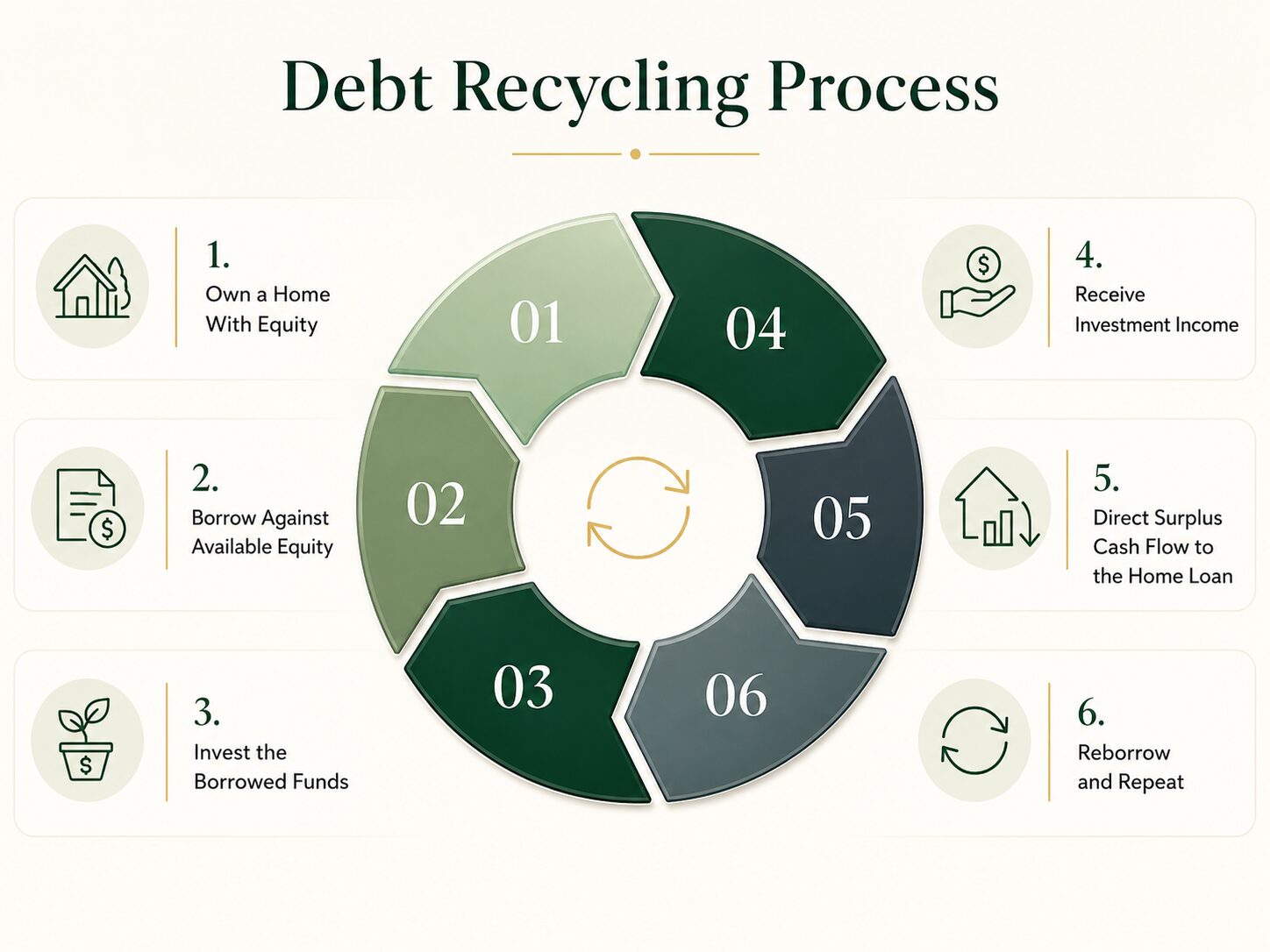
Debt recycling involves paying down part of a home loan and then borrowing that amount again through a separate investment loan split.

The borrowed funds are invested in income-producing assets, while future surplus cash flow continues to reduce the non-deductible home loan.

A typical strategy may involve:

  1. Reducing part of the home loan
  2. Re-borrowing through a separate investment split
  3. Investing in a diversified portfolio
  4. Reviewing and repeating the process gradually


Because the strategy involves borrowing to invest, it introduces both lending and investment risk and is not suitable for everyone.

How Debt Recycling Works at LOC Wealth

We keep it simple and measurable.

  1. Set your buffers and borrowing limits
    We confirm a comfortable emergency fund in your offset, a sensible loan to value ratio, and the right loan structure with separate splits so home and investment debt never mix.
  2. Attack the home loan
    Your salary surplus, tax refunds and any distributions are directed to the home loan or offset. This shrinks bad debt first.
  3. Re-borrow to invest
    We redraw or create a new split for the same amount that you’ve repaid and invest it into a diversified portfolio aligned to your risk profile.
  4. Rinse and repeat
    As investments generate income, that income helps reduce the home loan even faster, enabling the next recycle.
  5. Review and rebalance
    We check progress, rebalance investments, and adjust contributions when life changes, interest rates move, or goals shift.
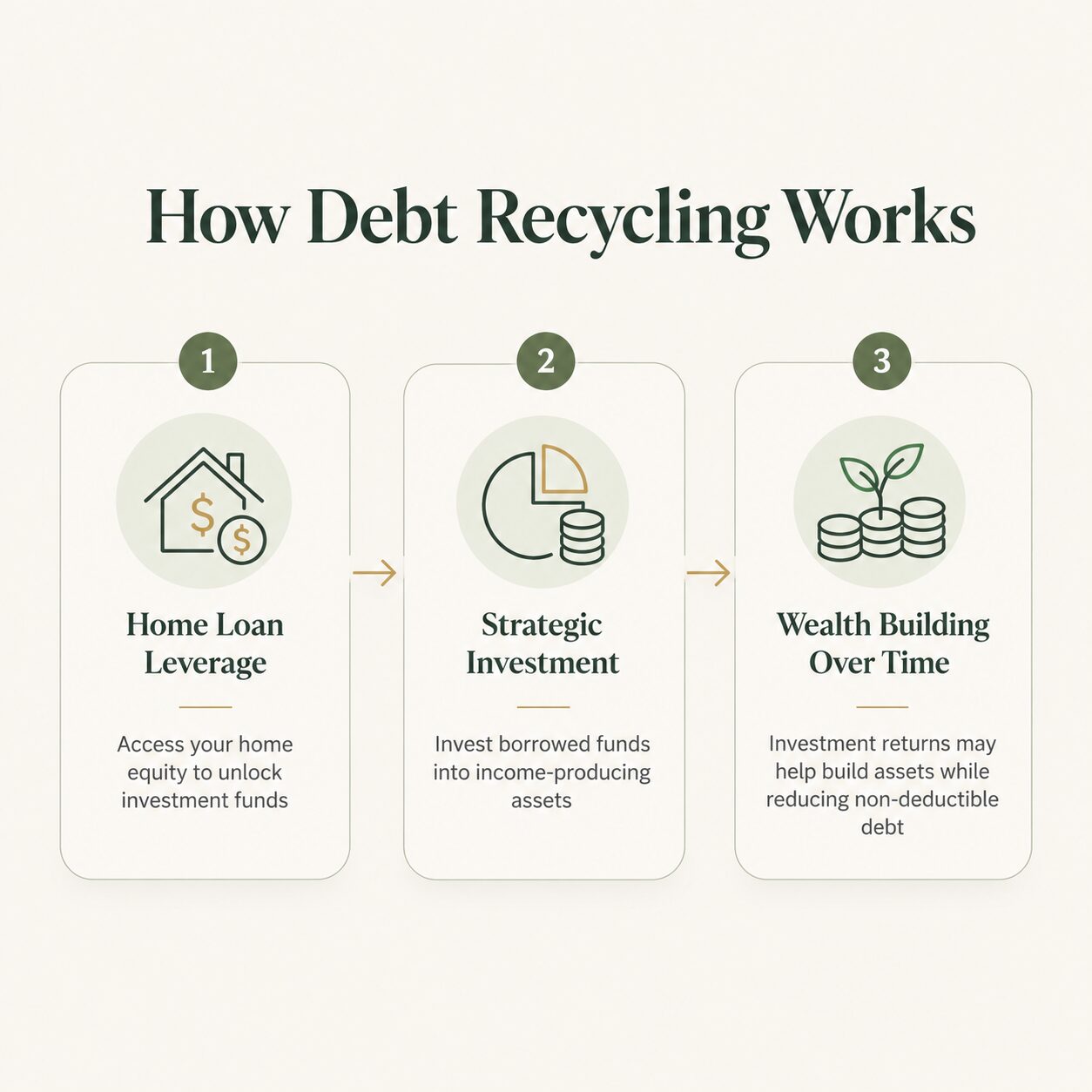
Three-step infographic showing home loan leverage, strategic investment and wealth building over time

The LOC Wealth Model for Wealth Management

Debt Recycling is just one part of our holistic wealth approach.

Our LOC Wealth Model combines lending, investment, and financial planning under one clear system.

It includes:

  • Debt Recycling – convert non-deductible debt into investments
  • Superannuation Growth – optimise your retirement savings
  • Investment Management – build a diversified portfolio
  • Risk Protection – ensure your plan is protected against the unexpected
  • Retirement Planning – map how your income will last

We use custom modelling tools to help you see your progress in real numbers — from your current home loan to your projected investment balance. Clients can visualise how their debt reduces and their wealth grows under our strategy.

A Simple Example

Let’s say you have a $600,000 home loan and free up $2,000 per month.
After 12 months, you’ve paid down $24,000.
We create a new $24,000 investment split, invest it in a diversified portfolio, and repeat the process annually.

Each cycle builds your investments while your home loan continues to shrink.
Over time, you’ve replaced debt with assets — turning your mortgage into a true wealth engine.

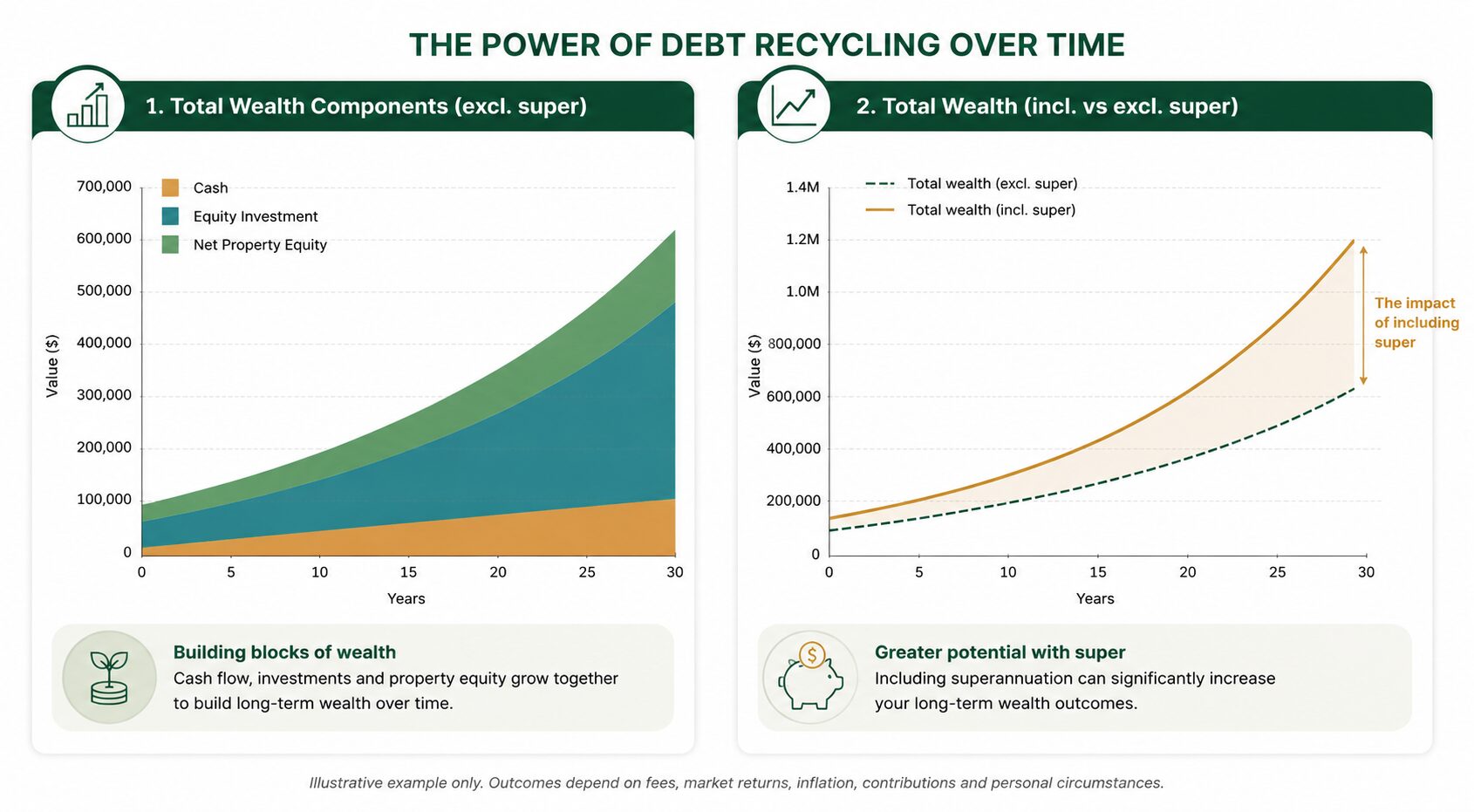
Illustrative charts showing long-term wealth components and total wealth projections with and without superannuation

Guardrails We Put in Place

We design every strategy to feel calm, controlled, and sustainable.

     ✅ Emergency buffer in offset
     ✅ Sensible maximum LVR for flexibility
     ✅ Interest-only on investment splits to protect cashflow
     ✅ Clean loan labels for tax reporting
     ✅ Diversified, low-cost investment selection
     ✅ Option to pause or slow down if rates rise or life changes

Frequently Asked Questions

What is debt recycling and how does it work?

Debt recycling is a long-term strategy that may help suitable homeowners gradually replace non-deductible home loan debt with investment debt.

A typical approach involves paying down part of the home loan, then borrowing that amount again through a separate investment loan split and investing the borrowed funds in income-producing assets. Future surplus cashflow can continue reducing the home loan while the investment portfolio is built over time.

Because the strategy involves borrowing to invest, it increases investment and lending risk and is not suitable for everyone. The loan structure, cashflow position, investment time frame and ability to tolerate market falls all need to be considered before implementing it.

Who might debt recycling be suitable for?

Debt recycling may be worth considering for homeowners who have stable income, surplus cashflow after normal expenses, sufficient home equity, an emergency buffer and a long-term investment time frame.

It also requires comfort with investment risk because the borrowed amount still needs to be repaid even if investments fall in value or produce less income than expected.

It may be less suitable where income is volatile, household cashflow is already tight, there is little emergency savings, borrowing capacity is limited, or the investor is uncomfortable with market movements. Suitability should be assessed using the household's full financial position rather than home equity alone.

Will my repayments or household cashflow go up?

Not necessarily, but debt recycling can change the way your lending and cashflow are structured.

The aim is to set a recycling pace that remains manageable rather than borrowing the maximum available. LOC Wealth considers your existing repayments, surplus cashflow, emergency buffer, interest rates and loan structure before deciding how much, if any, should be recycled.

If interest rates rise, investment income falls or household expenses increase, the strategy may need to slow down or pause. You still need to meet the loan repayments regardless of how the investments perform, so maintaining a comfortable cash buffer is important.

Is debt recycling the same as negative gearing?

No. Debt recycling and negative gearing describe different things.

Debt recycling is a strategy for progressively reducing non-deductible home loan debt and using separate borrowing to invest. Negative gearing describes a tax position where the deductible costs of an investment are greater than the income it produces.

A debt recycling strategy may result in an investment being positively or negatively geared depending on the income, expenses and interest costs involved. The objective should be the overall long-term financial strategy, not simply creating a tax deduction.

Is the interest on a debt recycling investment loan tax-deductible?

Interest may be deductible where borrowed funds are used for an income-producing investment, but the tax treatment depends on the purpose and actual use of the borrowed money and the individual's circumstances.

This is why keeping home lending and investment lending in clearly separated loan splits is important. Mixing private spending and investment spending within the same loan can make the tax treatment and record-keeping much more complicated.

LOC Wealth can help structure the lending and investment strategy, but tax deductibility should be confirmed with a registered tax adviser or accountant for your individual circumstances.

What happens if interest rates rise or investment markets fall?

Both are important risks to plan for before starting.

Higher interest rates increase the cost of the investment borrowing and can place more pressure on household cashflow. Falling markets can reduce the value of the investment portfolio while the loan balance remains payable.

LOC Wealth's approach is to build in guardrails such as maintaining an emergency buffer, using a sensible borrowing level, diversifying investments and reviewing the strategy regularly. If circumstances change, the pace of new recycling can be reduced or paused rather than continuing automatically.

Why are separate loan splits and clean records important?

The purpose of each borrowing matters, particularly where interest deductions may be claimed. Keeping the home loan and investment borrowing in separate, clearly labelled splits helps show which borrowed funds were used for investment and which were used for private purposes.

Investment loan funds should be used only for the intended investment purpose, with clear transaction records retained. Using the same split for private spending, home expenses and investment costs can create a mixed-purpose loan and make the deductible portion more difficult to determine.

Good record-keeping also makes the strategy easier to review with your adviser, lender and accountant.

Can I pause or unwind a debt recycling strategy?

Yes, the recycling process itself can generally be slowed or paused if your circumstances change. You do not have to continue creating new investment borrowing simply because the strategy has started.

However, pausing the strategy does not automatically remove existing investment loans or investments. You will still need to manage the existing loan repayments, and selling investments may have tax, transaction or market consequences.

Before making a major change, it is worth reviewing the lending, investment and tax implications together so you understand the effect on your overall financial position.

How does LOC Wealth approach debt recycling?

LOC Wealth brings the lending, investment, cashflow and financial planning sides together rather than treating debt recycling as a stand-alone loan strategy.

We first review your home loan, equity, borrowing capacity, emergency buffer, surplus cashflow, investment time frame and tolerance for risk. If debt recycling appears appropriate, we can then consider separate loan splits, a suitable investment strategy and a recycling pace that can be reviewed as circumstances change.

The aim is to make the strategy structured, measurable and sustainable, with the option to slow or pause when required.

What happens in a free Debt Recycling chat with LOC Wealth?

We start with a high-level review of your current home loan, estimated property value, available equity, household cashflow, existing investments and what you are trying to achieve over the longer term.

From there, we can discuss whether debt recycling appears worth exploring and the main lending, investment and risk considerations for your situation. If detailed personal advice or modelling is appropriate, we will explain the next steps and any relevant costs before you decide whether to proceed.

Is It Right for You?

Debt Recycling suits clients who:

  • Have a stable income and some surplus after bills
  • Hold equity in their home
  • Are comfortable with long-term investing
  • Want to build wealth strategically while reducing debt

It may not suit clients with volatile income or without an emergency buffer.

📞 Ready to See How It Could Work for You?

Book a free 30-minute chat with Dave to see how your home loan could become part of your long-term wealth plan.
We’ll model your current setup versus a LOC Wealth-optimised strategy — and show the numbers side-by-side.

Close enquiry form

Book a Free 30-Minute Consultation with Dave

A conversation to clarify what you would like to achieve and identify the most appropriate next step.

Book a FREE 30 minute consultation with Dave

No obligation, Speak directly to Dave